
How REV Ocean is Building the Future of Medical Preparedness at Sea
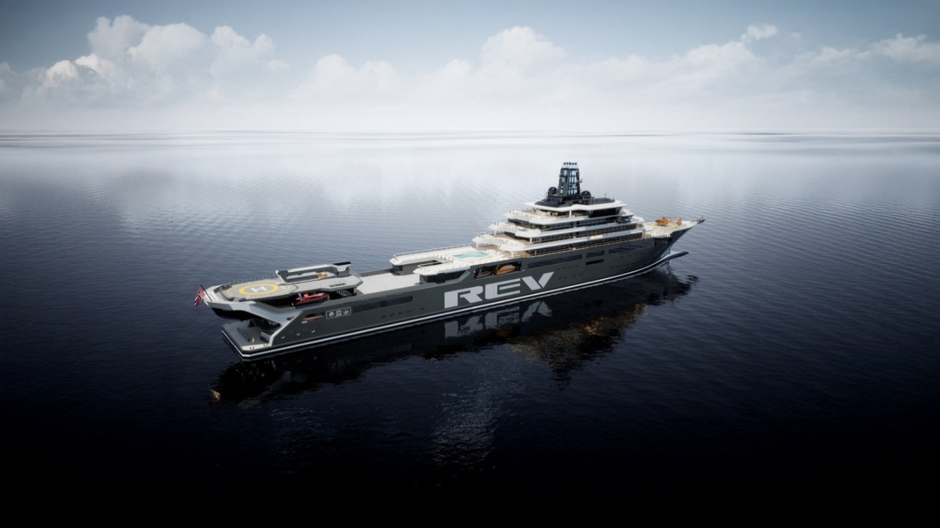
REV Ocean is set to become one of the world’s most advanced research and expedition vessels. From tropical waters to Antarctica, REV Ocean will operate in some of the world’s most remote regions. With potentially more than 100 people on board and the nearest hospital a long distance away, medical preparedness has become a central part of the project.
The project was initiated by Kjell Inge Røkke in 2017, with the ambition of contributing to research that will make a lasting difference for the ocean and future generations. At 195 meters long, the vessel is an impressive sight, but its size is primarily functional: to facilitate advanced research and expeditions.
With a submarine and a remotely operated vehicle on board, among other equipment, REV Ocean will explore parts of the ocean that remain among the least mapped areas in the world. When the vessel enters service, it will undertake expeditions in regions with limited infrastructure and long distances to medical assistance.
“We will be operating far from traditional medical support. We therefore need to ensure that we have the systems and expertise required to handle everything from minor health issues to serious incidents,” explains Peder Muri, Vessel Operations Director, REV Ocean.
One doctor on-board, an entire medical community on-shore
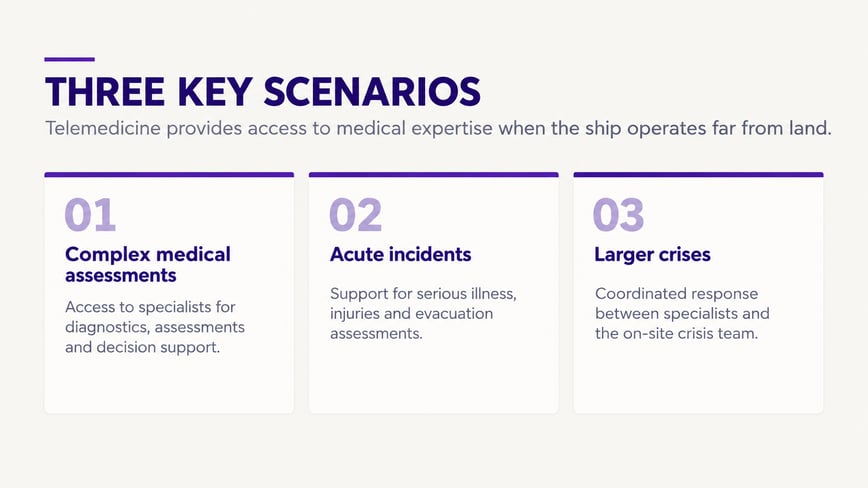
Risk and vulnerability assessments made it clear at an early stage that medical support needed to be a central part of the vessel’s preparedness. Even with a doctor on board, situations can arise that require specialized medical expertise, ranging from emergency medicine and radiology to psychology and other disciplines.
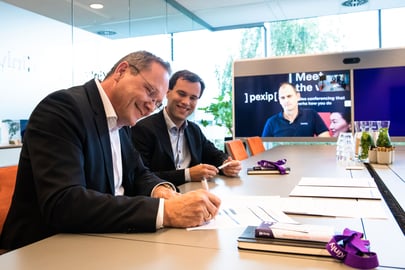
REV Ocean selected Kinly to develop and install an advanced telemedicine solution on-board, with Moloklinikken serving as its medical partner on-shore. The solution will give the crew access to medical expertise whenever it’s needed, regardless of where in the world the vessel is located.
Telemedicine makes it possible to involve shore-based specialists in real-time. Through the solution, the doctor in the ship’s hospital can access medical expertise from Moloklinikken and other specialists on-shore, whenever required.
“We cannot expect one doctor to know everything. Telemedicine gives us access to a broad network of specialists who can contribute assessments, decision support, and follow-up when necessary. The solution can be used for everything from planned consultations and sessions with psychologists to the management of acute medical incidents. It gives us an entirely different level of flexibility,” says Tor Harald Christiansen, Clinical Lead, Moloklinikken.
A development years in the making
The work to find the right solution began as early as 2019. For REV Ocean and Moloklinikken, it was essential to find a solution robust enough to function in challenging operational environments. In addition, experience in the offshore industry became an essential criterion during the evaluation.
“We knew that several organizations on the Norwegian continental shelf were already using Kinly solutions. That reassured us that this was technology capable of working under demanding conditions,” says Christiansen.
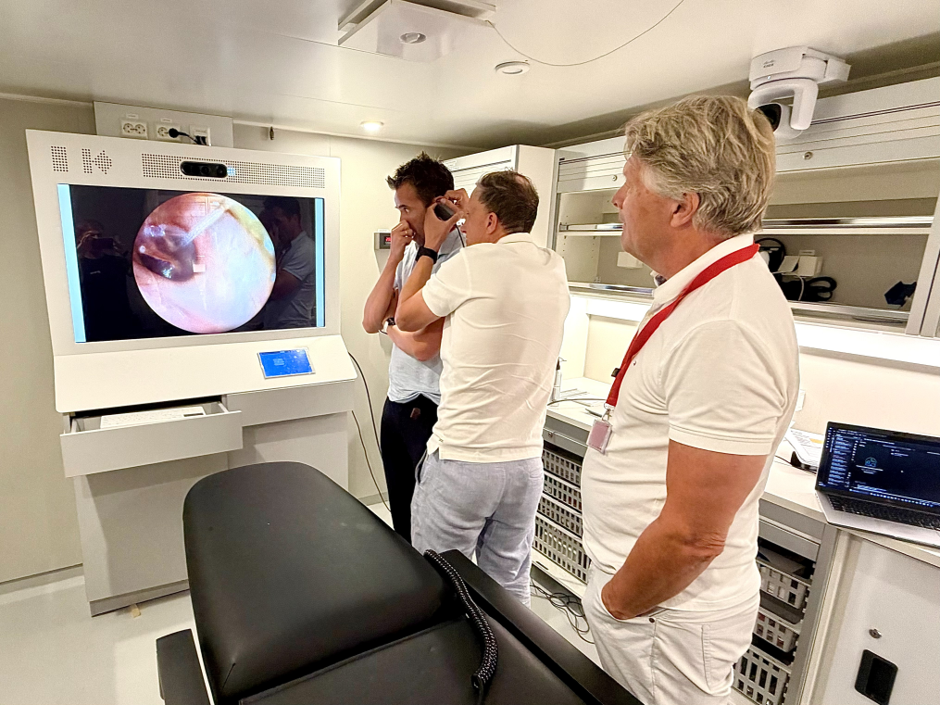
The solution has been, and continues to be, thoroughly tested. The team conducts extensive evaluations to ensure that audio, video, and medical equipment work together in a way that gives doctors the information they need.
It was particularly important that the system can support the doctor’s communication of medical data, including vital measurements and radiology. In addition, the solution had to be capable of functioning in specialist environments including a pressure chamber.
In the ship’s hospital, both the medical equipment and communications technology must work seamlessly together. Testing and quality assurance have therefore been central to the project.
“It is important to do all of this in advance. Once the vessel is out on a mission, making adjustments becomes far more demanding,” emphasizes Christiansen.
When the technology has to work
For REV Ocean, telemedicine is about far more than digital meetings between doctors. When the vessel is hundreds of kilometers from land, its medical preparedness must function under completely different conditions from those on-shore.
“Firstly, it means that the people on-board can feel secure and focus on the task at hand. Secondly, it means that unnecessary interruptions to the vessel’s work can be minimized, dangerous situations can be avoided, and situations can be prevented, says Christiansen.
This is crucial for REV Ocean because the vessel will operate in demanding waters and in regions where going ashore may be difficult. Remote access to medical expertise can therefore affect both how medical incidents are managed and how the mission itself can be carried out.
“It provides reassurance and increased medical support for the doctor on-board. Operationally, it means that we do not have to send people off the vessel or stop more often than necessary. We will be operating in demanding waters and in countries where it can be difficult to stop. Telemedicine makes us more resilient than we would have been without it. That is indisputable, says Muri.
Thinking of the smallest details
Although the vessel is not yet in regular operation, the team is proud of the work completed so far.
What stands out is not necessarily the technology alone, but the quality of the process behind it. For a project that must function far from land, the solutions need to be carefully considered, tested, and quality-assured before the vessel sets out on a mission.
“We are proud of the quality we are delivering in the ship’s hospital and throughout the rest of the vessel. Thorough work has gone into the equipment, testing, and quality assurance, and there is a clear rationale behind every solution we have chosen,” says Muri.
When REV Ocean sets out on its first missions, telemedicine will be a central part of the preparedness on board.
The ambition is simple: when the distance to land is measured in days, the distance to medical expertise must be measured in seconds.
Now only the journey remains. We look forward to following REV Ocean out to sea and are proud to contribute to medical preparedness that follows people on-board, no matter where the mission takes them.